

Why competitor tracking matters
When someone asks ChatGPT “What’s the best electric vehicle for long-range driving?”, the response typically mentions 5-10 brands. Your mention rate, rank, and share of voice are only meaningful when compared to the other brands in those same responses. Competitor tracking in Citivus helps you:- Benchmark your performance — See where you stand relative to known competitors
- Identify trends — Spot when a competitor is gaining or losing ground
- Discover threats — Get alerted when new brands start appearing in your space
- Prioritize actions — Focus optimization efforts on the competitors who matter most
Adding competitors
- During onboarding
- From the competitors page
When you set up a new brand, Citivus automatically identifies potential competitors based on your website analysis. You’ll see a list of suggested competitors — toggle them on/off and add any that were missed.
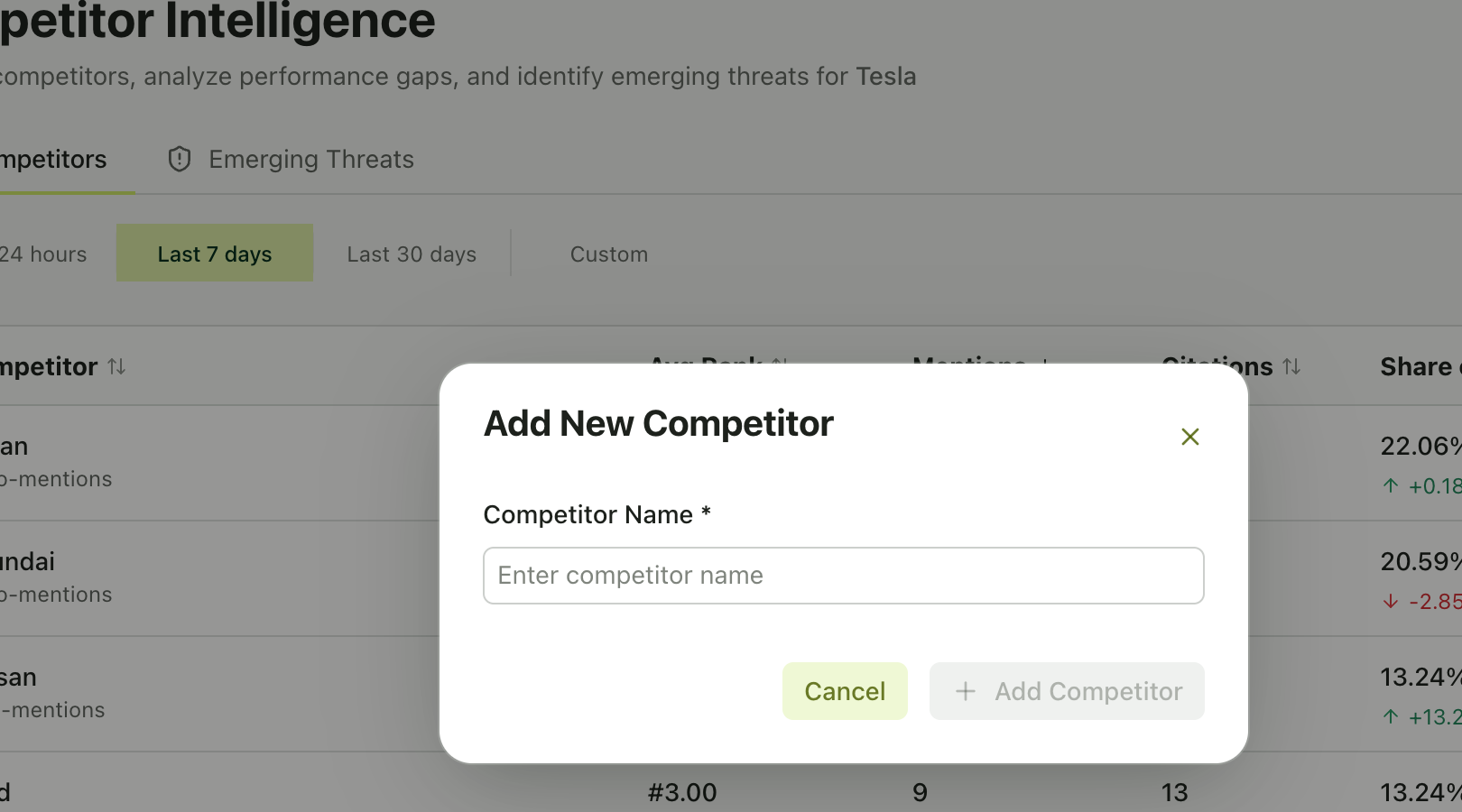
The competitors dashboard
The Competitors page gives you a comprehensive view of how each tracked competitor is performing: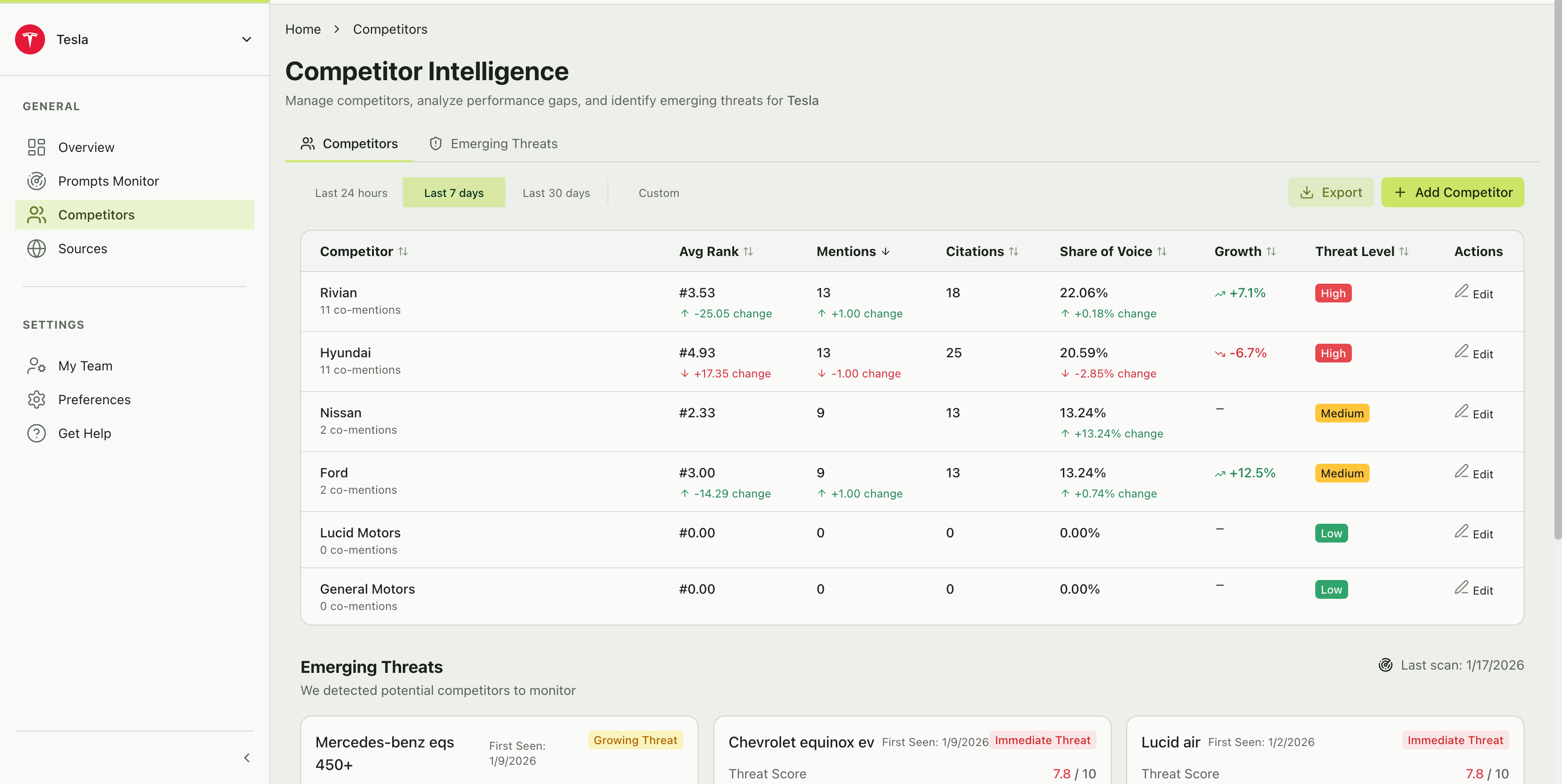
The Competitors dashboard with threat levels, share of voice, and growth indicators
Co-mentions are key. A high co-mention count means this competitor frequently appears in the same AI responses as your brand. These are your most direct rivals in AI search. If a competitor has high mentions but low co-mentions, they may be strong in prompts where you’re not even appearing — a different kind of threat.
Understanding threat levels
High threat
High threat
The competitor has strong mention rates, growing share of voice, and frequently appears alongside your brand. They’re actively competing for the same AI “real estate” you are.
Medium threat
Medium threat
The competitor shows moderate activity with some growth indicators. They may be gaining traction in specific prompt topics but aren’t dominant yet.
Low threat
Low threat
The competitor has minimal mentions or declining presence. They may not be a major factor in AI search results currently, but it’s worth keeping an eye on them.
Emerging threats
One of Citivus’s most valuable features is Emerging Threats detection. This automatically identifies brands that are appearing in your AI search results but that you’re not currently tracking as competitors. On the Competitors page, scroll down to the Emerging Threats section (or click the “Emerging Threats” tab). Each emerging threat card shows:- Brand name and when it was first seen in your results
- Threat classification — “Growing Threat” or “Immediate Threat”
- Threat score — A 1-10 rating based on frequency, position, and co-mention patterns
- Total mentions — How many times this brand has appeared across all prompts
- Key metrics — Average position, co-mention percentage, and number of unique prompts they appeared in
- AI-generated suggestions — Actionable recommendations for how to respond
Threat classifications
Review your Emerging Threats regularly. When you see a brand that’s clearly a competitor, click “Track” to add them to your monitored competitors list.
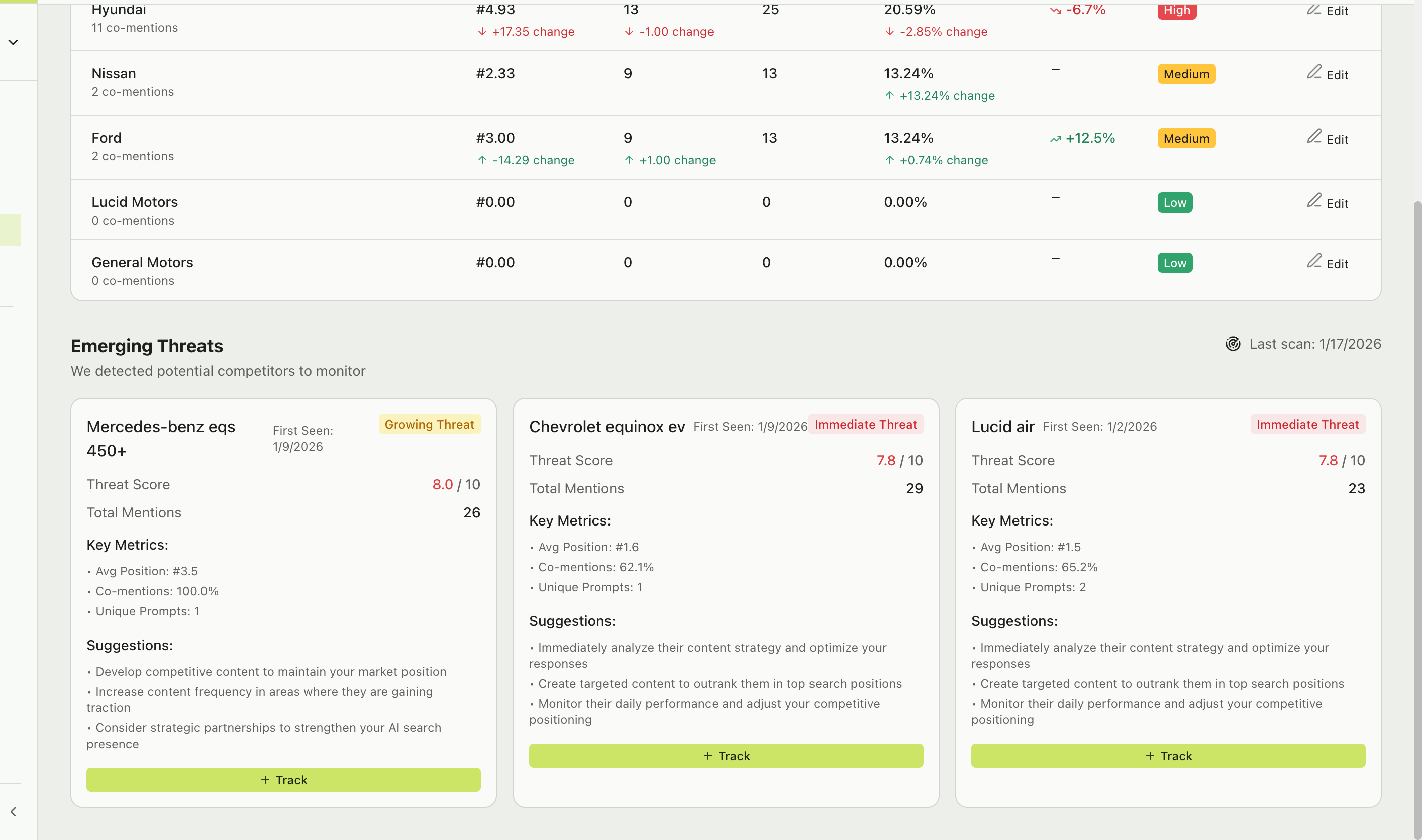
Emerging Threats cards showing newly detected competitors with threat scores and AI-generated suggestions
Competitor comparison
Click on any competitor’s name in the Competitors table to view a detailed comparison page. This gives you a head-to-head breakdown including:- Per-prompt performance comparison
- Provider-specific ranking differences
- Share of voice trends over time
- Content and citation overlap analysis
Best practices
Start with who you know
Start with who you know
- Add your 3-5 most direct competitors during onboarding
- Let Citivus’s Emerging Threats feature discover who else appears in your space
Review threats weekly
Review threats weekly
- Check the Emerging Threats section at least once a week
- Track any brand with a threat score above 6
Act on growth signals
Act on growth signals
- If a competitor’s growth percentage is consistently positive, investigate what they’re doing differently
- If your growth is negative while a competitor’s is positive, prioritize that competitive gap
Use co-mentions strategically
Use co-mentions strategically
- High co-mention competitors are your most direct AI search rivals
- Focus content optimization efforts on outranking high co-mention competitors